
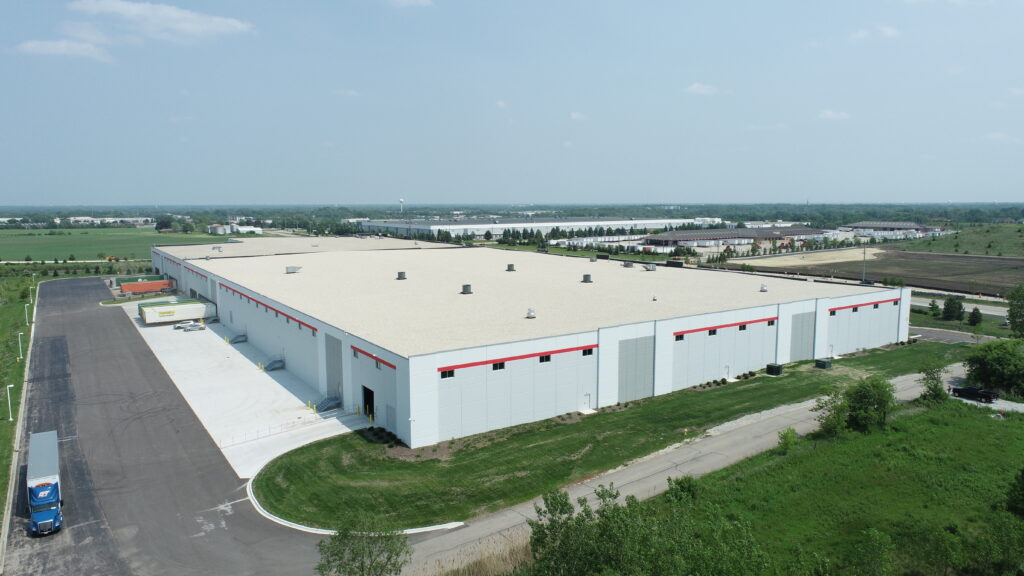
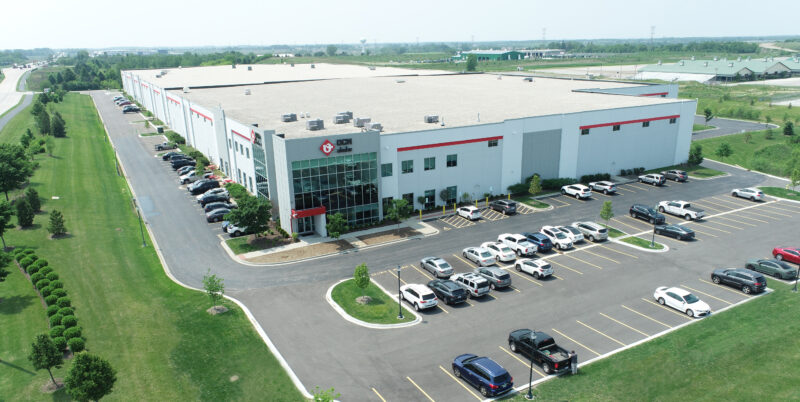
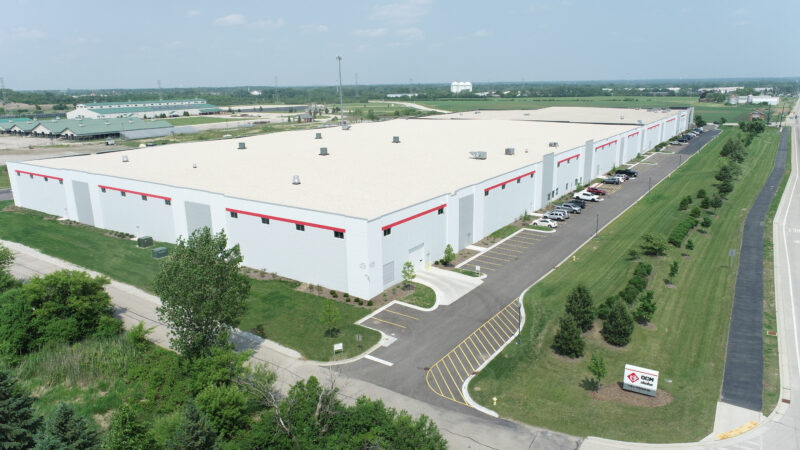
The OCM Expansion project involved the design and construction of a 203,257 SF warehouse addition to an existing 133,951 SF manufacturing facility in Grayslake, Illinois, bringing the total facility to 337,208 square feet.
This complex industrial expansion required careful coordination to support OCM’s operational growth without disrupting their day-to-day manufacturing activities. The project also included the construction of a new compressor room within the existing facility and significant power and utility upgrades to accommodate future equipment needs.
From planning through completion, Peak Construction overcame logistical, infrastructure, and regulatory challenges to deliver the project ahead of schedule and under budget, with an expanded scope of work—all while the client remained fully operational. This case study outlines the key obstacles encountered and the tailored solutions implemented to ensure success.
CHALLENGES AND SOLUTIONS
CONSTRUCTION WHILE MAINTAINING OPERATIONS
Challenge: The facility had only one access road, which also served OCM’s daily shipping, receiving, and employee traffic. Peak had to manage coordination of construction logistics without interfering with production schedules or safety, even while completing major sitework and structural activities.
Solution: Peak provided planning and maintained daily coordination details shared with OCM to communicate and make necessary plan adjustments in real-time to avoid any impact on OCM’s daily activities. Peak created temporary stone parking lots when existing parking was removed for utility work. Subcontractor access areas were updated weekly, and Peak staff personally directed traffic during key periods to ensure safe and efficient site movement. Peak utilized steel plate bridges over open trenches to preserve truck routes during underground utility installations. Phasing of work allowed for minimal disruption to the facility’s two-shift production schedule, ensuring uninterrupted operations throughout construction.
LONG PERMITTING PROCESS
Challenge: The village permitting process, typically targeting 40 days, was lengthened significantly due to limited municipal staffing and multiple third-party review layers. This unexpected potential delay of over three months resulted in a very significant challenge to our schedule.
Solution: Peak engaged directly with the village’s building commissioner and engineering staff early in the project. Through persistent follow-ups and relationship-building, Peak was able to secure phased approvals: first for mass grading, then for foundations, and finally for the full building permit. This approach enabled critical work to begin on schedule while broader approvals were still pending, maintaining project momentum despite regulatory delays.
SHALLOW EXISTING UTILITIES AND UNDERGROUND CONFLICTS
Challenge: During excavation, Peak encountered live electrical lines in unexpected locations—remnants of the original facility build that had not been documented or relocated correctly. These conflicts made it unsafe to proceed with parking lot and underground utility work as planned.
Solution: The team employed strategic potholing and hand-digging techniques to identify and verify utility depths and locations. When active lines were found in conflict zones, Peak coordinated directly with the electric utility provider to resolve the issues. Despite the delays, Peak adapted the schedule and sequencing of work to continue progress in other areas while waiting for utility relocation.
INTERNATIONAL EQUIPMENT & ELECTRICAL LOAD PLANNING
Challenge: OCM’s manufacturing process relies on specialized welding equipment sourced from Germany. Equipment specifications were non-standard and required electrical conversions to match U.S. infrastructure, but the required exact electrical demands, design information, including equipment placement, and specific voltages, phases and amperages were initially unknown.
Solution: Peak facilitated direct communication with the German engineering team to better understand the equipment requirements. Peak added a second electric utility service to accommodate the anticipated electrical loads, and also pre-installed infrastructure for electrical, compressed air, and water lines near the anticipated equipment locations. This strategic preparation ensured that future equipment hook-ups could occur efficiently without retrofitting or rework.
TRUCK ACCESS INSIDE THE FACILITY
Challenge: OCM requested a unique building access door to provide the ability to drive semi-trucks inside the facility for side-unloading of materials, an uncommon operational requirement in industrial construction.
Solution: Peak integrated a full-width drive-through lane into the facility’s design, complete with overhead door access, pitched floor for drainage, and a trench drain system. Peak implemented added ventilation using three exhaust fans—one running continuously and two activated by CO/NO2 sensors to manage emissions. This system allowed for safe, year-round truck access while maintaining air quality and interior cleanliness.
PARKING CONGESTION
Challenge: With a growing OCM workforce and construction activity from multiple subcontractor trades on-site, OCM’s existing parking faced severe shortages during the majority of the construction workday time periods.
Solution: Peak carefully phased parking lot construction and created interim stone-surfaced lots to ensure ongoing parking availability. The final site plan included 115 new permanent stalls, resolving the congestion long-term while preserving safe access for employees and trades.
CIVIL AND STORM INSPECTION ISSUES
Challenge: During inspections, third-party civil reviewers discovered existing building and site infrastructure deficiencies beyond the original addition scope. These included storm structure movements due to clogged underground drainage components that would impact occupancy approval.
Solution: Despite this unexpected, and unrelated addition, scope on the original site and building, Peak remediated the issues to maintain schedule. Corrective actions included pavement removal, structure realignment, and full system cleanout. Peak’s willingness to resolve inherited issues helped preserve the client relationship and occupancy timeline.
PAINT MATCHING AND BUILDING APPEARANCE
Challenge: Due to current environmental regulations on paint products, Peak could not use the original material and this resulted in being unable to match the original precast surface, which had also faded over time. The mismatch became highly visible once new construction began.
Solution: Peak coordinated a repainting of the entire exterior to unify the building’s appearance. Work was carefully scheduled to avoid operational disruption, particularly around loading docks and employee entrances. This aesthetic update helped align the expansion with the original structure and presented a cohesive visual identity for the facility.

OUTCOMES
Despite an expanded scope and considerable technical challenges, Peak Construction delivered the OCM Expansion project two months ahead of schedule and under budget. The facility now has increased capacity, upgraded infrastructure, and operational enhancements that will support OCM’s future growth.
Peak’s ability to maintain operations, adapt to changing needs, and communicate transparently at every stage resulted in a highly successful project and new long-term customer relationship —recognized by a letter of recommendation from the client.
The OCM Expansion highlights Peak’s commitment to delivering the right solutions and doing the right thing—every time.
Contact Peak Construction about your next Industrial project.